Welcome to My Professional Blog- Post #1
Hello!
My name is Kelsy and this is my last (*fingers crossed*) semester in the MLIS program at UWM. After graduation, I hope to continue in the district I work in as a Library Media Specialist. I currently work as a library assistant for an IB high school in Green Bay and genuinely love my job. Most of my blog post will center on how libraries play a role in reading content. I don’t have any classroom experience but do work closely with all departments on making sure our readers have the materials and skills they need to succeed.
Some of my favorite resources are below. These have helped me a lot with reader’s advisory:
My home page will always feature the titles I’m reading/read, but I’m always looking for suggestions (I tend to dabble in all genres). When I’m not working or doing school work, I can be found hanging out with my dog Charlie or planning my next trip. The picture above is from my 2019 trip to Ireland.
Blog Post #3
Working in the library, our focus is usually on supporting classrooms and classroom teachers; helping them find supplemental materials for their lessons and creating new ways to introduce topics and assignments. A great way to combine the literature found in libraries and the curriculum found in the classroom would be to team up with fiction writing or children development classrooms to show them the importance of not only reading to children but also providing them access to a diverse selection of materials. It is here that we can bring to the attention of future educators/childcare workers and potential authors, an issue that has been plaguing the book industry for years.
The lack of diversity in children’s book is beginning to a lot of attention…as it should. It’s been a long time coming and an issue librarians can’t address alone. 81% of librarians surveyed in School Library Journal’s survey considered it to be a “very important” issue. This lack of representation has been linked to decrease reading motivations and achievements for student of “non-white” backgrounds. Bringing this issue to the attention of high school students enrolled in child development courses and/or fiction writing classes, not only builds a connection for the school library but helps create background knowledge on an issue many of these student will likely run into should they choose to continue in these fields.
These resources will begin to look at the importance of first reading to children and the life long skills they can develop and then look at the need for a more diverse collection. Through videos, images, and articles, we can show high school students learning about the development of children or how fiction is created, the importance of a diverse children’s collection.
Multimedia texts
Resource #1
TEDxEHC.” Youtube, 26 Apr. 2016, http://www.youtube.com/watch?v=Yq2opVinciA.
Accessed 6 Apr. 2020.
Summary: Byrnn Welch gives a TED talk on how unprepared the book industry is when it comes to representing a diverse collection for children. She talks about how many of the children’s books she was picking up for her African American son did not represent him and the options that did were limited. Dr. Welch goes on to talk about “white being the default” for all books and how damaging that can be for children who are trying to connect with literature. These issues, she says, do not stop at race but continue throughout literature when looking at expressing areas like sexual orientation, family structures, religion, etc. and this is simply not acceptable.
Qualitative and quantitative measures: Ted talks are “devoted to spreading ideas, usually in the form of short, powerful talks.” These formats (short/powerful) allow for opinions to be shared across several platforms. Ted talks formats have been adapted by a multitude of organizations which allow for smaller events (Tedx) to take place. Based on Dr. Welch’s presentation and the limited number of vocabulary words that would need to be defined (see below), I think this video would be perfect for high school students. While the limited vocabulary words may suggest an easier reading level, how Dr. Welch addresses the issue (as a mom and consumer of literature) may not resonate with a young audience. This video is available on youtube, without a subscription and would be accessible to anyone with access to an internet compatible device. Recommended vocabulary words: diversity, CCBC, stereotypes, default, ethics
Task and reader complexity: I would use this video as a means to reiterate the issue that the book industry (and children’s books in particular) lack a general sense of diversity. Being that it is a video, I would hope students would find more interest in the topic and that it would further help them gain and understand on the topic. Because the purpose of these texts would be to show high school students in children development classes or fiction writing classes, the importance of having a diverse collection of children’s literature, I would introduce this video after establishing deeper background knowledge on the issue. This video would serve as a motivation and as a means to activate background knowledge.
Resource #2
watch?v=5_8H-O8iA88&disable_polymer=true. Accessed 6 Apr. 2020.
Summary: Lack of Asian American characters in children’s books lead this dad to create a story for his daughter to connect with. After his daughter expressed she didn’t want to be Chinese, her dad decided that he needed to show her, through literature, that it was okay to be who she was. This would be my “call to action” and would be great for motivating the fiction writing students to look at aspects of their lives that aren’t represented in literature and question what they can do to make sure they are.
Print texts
Resource #3
The Importance of Reading to Your Children

Children’s Bureau, 3 Mar. 2017, http://www.all4kids.org/news/blog/
the-importance-of-reading-to-your-children/. Accessed 6 Apr. 2020
Summary: This brief blog post talks about the importance of reading to children and the different research behind it. While it does not go in depth on each research case, it does cover the main reasoning for reading to your children; supporting cognitive development, improved language skills, prepare for academic success, creating a special bond with your child, increased concentration and discipline, improved imagination and creativity, and cultivate a lifelong love of reading.
Qualitative and quantitative measures:
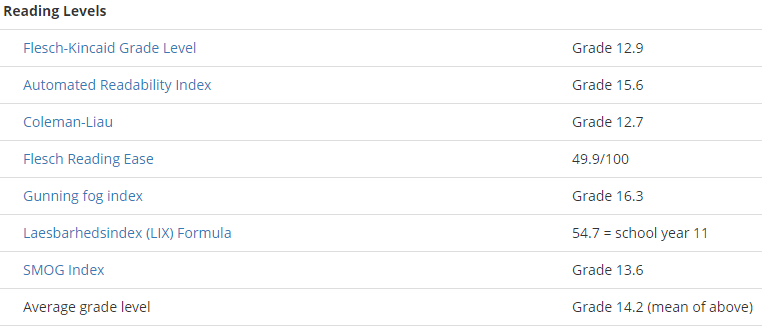
Based on the information above from storytoolz, this text reads at a college level, which I strongly disagree with. The subject matter is relevant and the format (blog post) is a style that many of our students would be familiar with. While many of the case studies might have more difficult language or context, I do foresee our students having an issue reading/understanding this article. Again it is very likely that the students in the child development class have some background knowledge already and understand terms like cognitive development and phonemic awareness; and for those who don’t the article does a great job at giving basic definition throughout. Recommended vocabulary words: cognitive development (already defined in article), phonemic awareness (defined in article), language acquisition, comprehension, phonics (defined in article).
Task and reader complexity: Students in the child development class will likely already have knowledge on this subject. I would suggest working with the teacher to make sure that the information in post making the information in any textbooks they may have for class. I would use this article first to gain interest of the students and establish background knowledge of the subject. From there I can help them understand the special role representation plays in children’s books and why diversity is so important. Without this article students might not understand why the issue is so important or how it could affect their future jobs in childcare/education/writing.
Resource #4
Summary: A deeper look at the impact of representation in children’s books and how it can affect long-term appreciation and development of skills. A 14 page case study and analysis of how children process literature and the characters in the books. Details ways educators can get involved in order to correct this issue. Using this with my students, I would have them look closely at the study conducted and the concluding evidence. While this is a longer document, I think the numbers and graphs help break it up and would be a great addition to showing the student exactly how important having a diverse collection of literature is. With the knowledge they will have gain of the importance of reading to children from the article above, it will hopefully show them that while it is important to read to children, it is equally important to read stories to children they can connect with.
Culturally Relevant
Resource #5

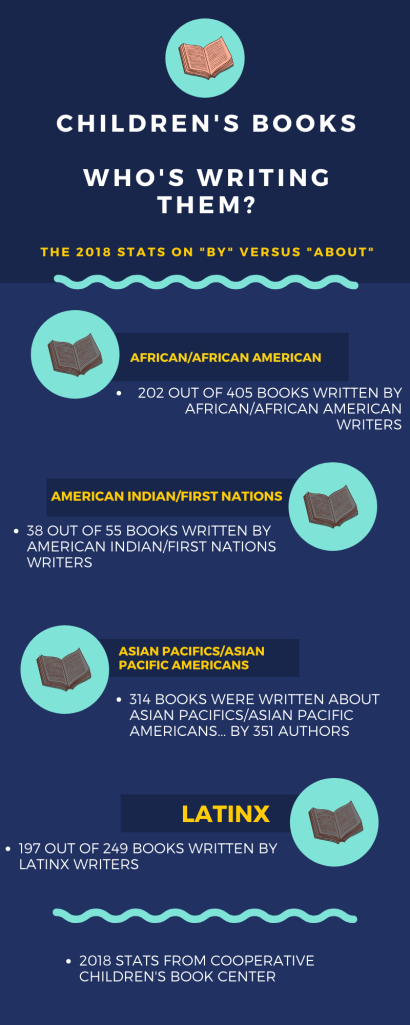
Summary: This picture, using statistic complied from the CCBC (see resource #6) show how little non-white/animal children are represented in children’s books.
Quantitative and Qualitative: This image, while seemingly simple in nature, does have a lot of imagery to unpack. Younger students might see the picture and think of it only as a cartoon, but older students will need to unpack not only the the percentages of each race/ethnicity but how the illustrator chose to show those percentages. Each child/animal is given a chance to see themselves (mirrors) how frequently they see themselves is depicted by the size and amount of mirrors. White children and animals/other get to see themselves the most in children’s books and therefore have the largest/most mirrors. African Americans, Asian Pacific, Latinx, and Native American see decreasingly smaller books with characters depicting their likeness and therefore receive smaller and defective mirrors. This makes the image a little more difficult to understand but something that can have an impact when trying to show students in child development and fiction writing classes, the importance of finding (or writing) material that represents all students.
Task and reader complexity: As mentioned above while the image is in the form of a cartoon there are aspect to the picture that require a deeper level of thinking. I would use this image as a supplement to the statements found in resources 1,2, and 4. Not only does this job do a great job to motivate interest but it does it in a way that brings cultural awareness. Student’s prior knowledge of the importance of reading to children will help them understand how little children of color are being represented.
Resource #6
Cooperative Children’s Book Center Vision Statement

Children’s Book Center, The University of Wisconsin Madison,
ccbc.education.wisc.edu/about/vision.asp. Accessed 6 Apr. 2020.
Summary: The CCBC is a vital tool in understanding the efforts of providing a more diverse world of literature. The vision statement is just one small part of a website that can provide all, with the facts and information needed to combat the “all white world of children’s books”. I would use this as a resource for the students to explore on their own. There are a lot of resources provided by the CCBC and their vision statement is just one of the avenues they can explore. Working with students in these classes should know about the resources available to them in the future and what organization are doing to bring awareness to the issue. CCBC website would be an ongoing tool for students to find materials to supplement any potential future careers in childcare/education/literature.
Grad. Post
According to Fang and Croatian the differences between CAL (Content Area Literacy) and DL (Disciplinary Literacy) are as follows:
CAL (content area literacy): is a developed literacy skills that is used a “generic tool”
DL (disciplinary literacy): the development of other skills (social, semiotic, cognitive) have direct relation to how well the student is able to engage in other literacy aspects (Fang).
For me, it’s hard to apply these in my area. Working in a library brings on a different set of challenges that aren’t always apparent in the classroom…or have to deal with reading. While we see hundreds of students everyday, what they need from us isn’t always literacy based. Many times it’s technology or a quite workspace. So in order to understand CAL and DL, I had to really understand how the articles were going to break it down.
After gathering the general definition of each, my first instinct was that DL wasn’t going to be a skill that many readers naturally developed. And throughout the 3 articles, it seemed my suspicion was right…or at least in part.
Fang and Coatam talk about this on page 629; the idea that DL is only for those in “advanced classes.” If we take the idea that DL cannot exist without a solid foundation (CAL) it does beg the question; does this higher level of thinking demand too much of students, especially if a solid general (or generic) skill set isn’t there? How do you encourage students with “lesser” basic reading abilities to want to continue to read and be engaged? And while there may be some merit to this thinking, I fear it is too often that these “generic” skills are developed or focused on but don’t offer students a connection to that “higher thinking”…there are no connections to something that may allow thoughts to extend beyond the classroom when CAL is the only focus.
As I mentioned above, before reading the article, I asked myself how this information could pertain to the library. What do we ask our patrons to do on a daily basis? Collaborations between the library and the classroom are common but generally focus on basic research skills. (Usually unable to delve deeper due to time restraints.) At the high school level, weekly check outs or classroom visits are rare; there isn’t enough time in the day for classroom teachers to come down and have their students check out books when they have a large variety of things they need to cover in the classroom (and textbooks that provide the majority of that information). In ELA, while some teachers are able to take some liberties with the texts they read, the required books are still there (Spratley and Lee talk about this “Limitation to range of texts” and how this can impact the desire to want to “think deeper”.)
The bottom line:
Understanding the differences between CAL and DL, I don’t think I can place a higher importance of one over the other. Without those “generic skills” (CAL), the development of those higher connecting skills cannot be complete. However, I think DL helps promote literature appreciation, but only if we give readers the materials they want to read. But literature appreciation is sometimes hard to come by. We don’t see a lot of (what I like to call) leisure readers and this is the easiest connection I can make to CAL and DL skills. For some, that “want” to read outside of the requirements will redevelop later in life, for others it will never happen. Our job as library staff is to spark that interest so that hopefully they will find that and be able to read the books (or find reliable sources) and understand the deeper meaning. Brozo et. Al talk about this spark and creating and maintaining it between “literacy specialist” and “content area specialist”; and in part I think that is what library staff can be.
“Only a small percentage of students graduating high school remain lifelong readers of the kind of canonical texts that the literature curriculum hopes to apprentice them into appreciating.” (Spratley & Lee)
How we encourage lifelong readers:
Library displays should offer engaging material that easily translates from classroom to leisure. Interactive monthly displays like poetry month for April, can help promote the kind of conversations students are used to having in the classroom without the demand of a grade.
For poetry month we do blackout poetry. By taking pages out of old books, newspapers, magazines we give students the opportunity to create their own unregulated poetry. Students take a black sharpie and cross the words they don’t want to use. Students are not only able to reinvent the text but also gain a new appreciation and understand the different ways poetry can be created. While they may have developed the “generic skill” (CAL) in their ELA class, the potential for a deeper level of thinking or appreciate (DL) is great and tends to encourage other curiosities.
Video to blackout poetry: https://youtu.be/Maed55XObjU
Blog #2- What I know and what I want
So many of our goals in the library include providing our students with a diverse enough collection of books that, at any time when they browse the shelf they are able to find something they can connect with. Movements like #WeNeedDiverseBooks and #OwnVoices provide guidelines for us to use as we, the library, look to give our student an authentic experience.
What I know and understand is the importance of having a diverse collection. I can recall the first book that I truly connected with was a Toni Morrison book called The Bluest Eye… it was my sophomore year of college and after reading it I wondering what took me so long to find her? The books required of us at the high school level included very little (if any) diverse characters. (The only black character I remember reading about was Tom Robinson in To Kill a Mockingbird.) This lack of diverse materials, prolonged connections for me. Reading more Morrison lead to an appreciation of Angelou, which lead to a rediscovery of poetry (and not Shakespeares’ sonnets) and the beauty of slam poetry, which lead to reading more books in verse.
What I want to know is how can we make this happen for our students? The library, being a voluntary place for many (especially at the high school level), tends to focus more on technology and research. And while reading in those areas (especially research) is a skill staff of the library can work with students on, what I’m more interested in is getting students excited about reading outside of the classroom. I feel it’s a skill that many can use to help them in other classes. It’s the idea of rediscovery, how can you make what you’re learning about in your core classes, fit your interests? (Or what are you interests if you don’t already know?)
What kind of connections do students really make when reading books that feature characters of similar backgrounds/genders/race/etc., is there anything we can do to help them make those connections and encourage deeper thinking?


 Rusch-Currins 545